
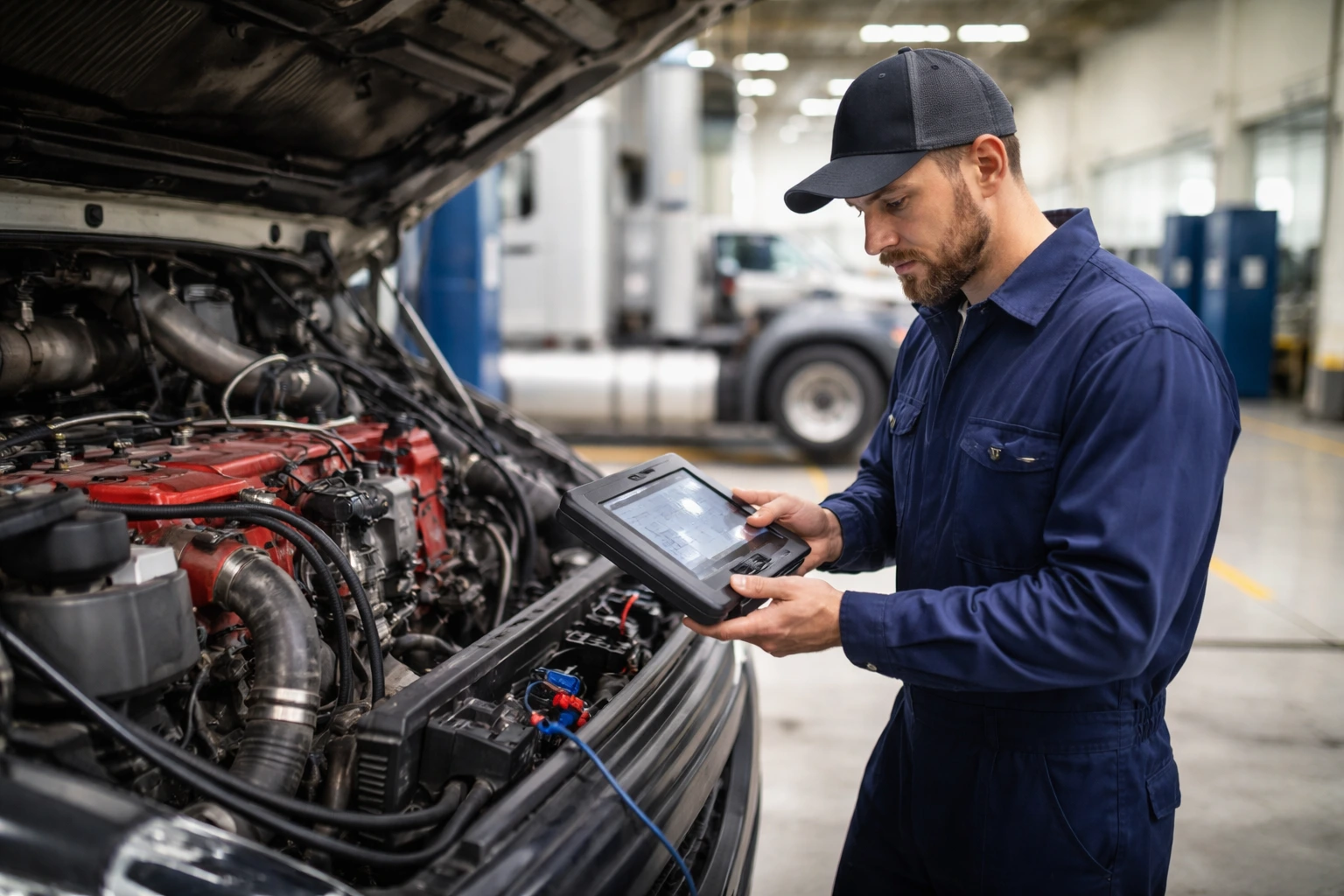
When a diesel engine stops on a Brisbane job site at 6am on a Monday morning, the cost of standing around waiting for someone to show up is measured in hours, crew wages, delayed deliveries, and penalties that compound fast.
have been working as a diesel mechanic Brisbane operators call across South East Queensland for years and the one thing that separates the operations that manage breakdowns well from the ones that get badly hurt by them is the same every time they have a relationship with a reliable mobile diesel mechanic before something goes wrong, not after they are already stuck on the side of the Ipswich Motorway with a prime mover that will not start.
This guide covers what diesel engine repairs and maintenance actually involve for Brisbane operators working with trucks, earthmoving equipment, forklifts, cranes, and fleet vehicles.
It covers why diesel engines in Queensland’s operating conditions degrade faster than operators sometimes expect, what the most common failure points are, how a proper preventative maintenance schedule reduces emergency callouts significantly, and how to evaluate a diesel mechanic Brisbane operators can genuinely rely on when it matters.
Why Diesel Engine Maintenance Is Different in Brisbane’s Climate
Brisbane’s subtropical climate creates specific conditions for diesel engines that mechanics in cooler states genuinely do not deal with to the same degree. The combination of high ambient temperatures, high humidity, and the intense operating cycles that Queensland’s construction, transport, and logistics industries demand creates accelerated wear on several engine systems that operators sometimes underestimate until the wear manifests as a breakdown.
Heat is the primary enemy of diesel engine longevity in Brisbane conditions. Coolant systems that are functioning at the borderline of their rated capacity during a Melbourne winter operate at or past their limits during a Brisbane summer when ambient temperatures regularly exceed 35 degrees and engine bay temperatures on trucks and earthmoving equipment in direct sun can reach 60 degrees or more.
A cooling system that has contaminated coolant, a partially blocked radiator from dust and debris accumulation, or a thermostat that is not opening fully enough will push an engine into operating temperatures that accelerate cylinder liner wear, head gasket stress, and turbocharger bearing deterioration significantly faster than the service manual’s projected wear rates assume.
Dust and contaminant loading on Brisbane construction sites particularly on civil infrastructure sites across Acacia Ridge, Wacol, and the western growth corridors places heavy demands on air filtration systems.
A diesel engine running on a dusty site with a partially blocked or compromised air filter is drawing hard to pull enough air volume through the restriction, and the air it does draw is carrying particulate matter that passes the degraded filter media and reaches the turbocharger and combustion chamber.
The resulting wear is real, measurable, and significantly shortens the interval between major engine repairs compared to a well-maintained filtration system.
The Most Common Diesel Engine Repairs BHS Sees in Brisbane
Understanding the most common diesel engine failure patterns in Brisbane’s operating conditions helps operators recognise early warning signs before a manageable repair becomes a complete engine failure. As a diesel mechanic Brisbane operators across South East Queensland rely on, the BHS Equipment team sees consistent patterns across the full range of trucks, earthmoving equipment, and industrial machinery we service.
Injector failure is one of the most common diesel engine repairs across Brisbane’s truck and earthmoving fleet. Modern common rail diesel injection systems operate at extremely high pressures 1,800 bar and above on late-model engines and they are sensitive to fuel quality, contamination, and the gradual wear that accumulates with operating hours.
Injectors that are beginning to fail are often present with rough idle, increased fuel consumption, visible smoke on acceleration, and eventually misfiring under load. Catching injector wear early with a proper injector flow test and pressure analysis means replacing individual injectors rather than dealing with the secondary damage that severely worn injectors cause to combustion chambers and pistons when they fail completely.
Turbocharger failure is the other consistently high-frequency diesel engine repair across Brisbane’s heavy equipment fleet.
Turbochargers are oil-lubricated high-speed components that operate in an extremely demanding thermal environment, and they are vulnerable to oil contamination, oil starvation caused by delayed servicing, and bearing wear from the abrasive particles that enter the engine when air filtration is compromised.
The warning signs of turbocharger issues increased exhaust smoke particularly on startup, reduced power under load, unusual noise from the turbo housing, and oil consumption that is higher than normal often present for weeks or months before a complete turbocharger failure occurs. Identifying and addressing these signs during a scheduled service visit prevents a turbocharger replacement from becoming an engine replacement.
Fuel system contamination is particularly prevalent in Brisbane’s earthmoving and construction equipment fleet.
Water ingress through tank vent systems on equipment operating in wet conditions, degraded fuel stored in site tanks, and microbial growth in fuel systems that sit partially full during wet season periods all introduce contamination that damages injectors, high-pressure fuel pumps, and common rail systems. A fuel system inspection and flush as part of a scheduled service catches this before it causes component damage.
What a Professional Diesel Engine Service Covers
A proper diesel engine service from an experienced diesel mechanic Brisbane operators trust is not just an oil and filter change with a visual inspection. For Brisbane’s operating conditions and the equipment types BHS Equipment services across South East Queensland, a thorough service covers a systematic inspection of every system that affects engine longevity and reliability.
The engine oil and filter service is the foundation but the condition of the oil being drained tells an experienced mechanic significant information about what is happening inside the engine.
Oil that has turned grey indicates coolant contamination, pointing to a head gasket or liner seal issue that needs investigation before it becomes catastrophic. Oil that smells strongly of diesel indicates fuel dilution from injector seal failure or excessive idling. Metal particle content visible on the drain plug magnet indicates internal bearing or component wear that needs further investigation.
Coolant system service covers coolant condition testing for pH, inhibitor concentration, and contamination, thermostat function testing, radiator flow assessment, and pressure testing of hoses and connections.
In Brisbane’s ambient temperatures, a cooling system that is at 80 percent of its rated efficiency in cooler conditions is likely operating at or above its limits in a Queensland summer. Cooling system maintenance is one of the highest-return preventative maintenance activities available for Brisbane diesel engines.
Air filtration inspection covers the primary and secondary filter elements, the condition of the filter housing and sealing surfaces, and the air intake ducting for cracks or connections that allow unfiltered air to bypass the filter entirely. Restriction indicator testing confirms whether the filter is approaching blockage threshold before it affects engine performance.
Fuel filter service, injector nozzle cleaning, fuel system pressure testing, and a full diagnostic scan of the engine management system round out a comprehensive service.
For fleet operators managing multiple vehicles and equipment across Brisbane, working with a diesel mechanic Brisbane specialist who provides consistent service records and maintenance scheduling takes the administrative burden off site managers and ensures nothing falls through the gaps between service intervals.
Mobile Diesel Mechanic vs Workshop
The decision between taking equipment to a workshop and booking a mobile diesel mechanic Brisbane service is one that Brisbane operators should make based on the specific equipment type, the severity of the repair required, and the cost of downtime versus transportation.
For trucks, prime movers, and equipment that can be driven or towed to a workshop without excessive cost or risk, major repairs, engine rebuilds, gearbox overhauls, significant structural work are often better handled in a controlled workshop environment with a full tool set and lifting equipment.
For on-site servicing of earthmoving equipment that would require a low loader to transport, for breakdown response when equipment has stopped working on a site or on the road, and for fleet servicing at a depot where multiple vehicles can be serviced without leaving the yard, mobile diesel mechanics deliver dramatically better value than workshop-based servicing.
BHS Equipment’s mobile service capability covers all of Brisbane’s major industrial and construction corridors from Acacia Ridge and Wacol in the south through to Brendale, Eagle Farm, and Pinkenba in the north, and across the Logan, Gold Coast, and Sunshine Coast corridors.
The 24/7 breakdown response service means a trade-qualified diesel mechanic can be on site for emergency breakdowns without the multi-hour wait times that workshop-only operations require when their trucks are already deployed.
For operators managing elevated work platforms, boom lifts, and scissor lifts, EWP maintenance as part of a combined service schedule with diesel engine servicing keeps all equipment on a single maintenance calendar and reduces the administrative complexity of managing multiple service providers for different equipment categories.
Diesel Engine Maintenance Schedules for Brisbane’s Operating Conditions
|
Service Type |
Standard Interval |
Brisbane Operating Conditions |
|
Engine oil and filter |
250–500 hours or 6 months | Shorten to 250 hours for dusty or hot conditions |
| Air filter inspection | 250 hours |
Check monthly on dusty sites |
|
Fuel filter service |
500 hours | Shorten to 250 hours with poor fuel quality |
| Coolant service | 1,000 hours or annually |
Annual testing essential in Brisbane heat |
|
Injector service |
2,000 hours | Advance if fuel consumption increases |
| Full engine diagnostic | Annually |
Essential for all Brisbane fleet equipment |
|
Turbocharger inspection |
1,000 hours |
Critical after oil-related service flags |
The intervals above should be treated as starting points adjusted based on actual operating conditions. Equipment operating on dusty civil sites in Brisbane’s western growth corridors needs more frequent air filtration checks than equipment operating in cleaner conditions.
Equipment running extended hours in Brisbane’s summer heat needs cooling system monitoring more frequently than the annual standard suggests. An experienced diesel mechanic Brisbane operators work with regularly will understand these adjustments and build them into your maintenance schedule rather than applying a one-size-fits-all interval regardless of actual operating conditions.
Diesel Mechanic Brisbane: What to Look for Before You Commit
The Brisbane heavy equipment and transport industry has no shortage of diesel mechanics offering servicing and repair. Understanding what separates a genuinely capable and reliable service provider from an operator who will overpromise and underdeliver protects Brisbane operators from the particularly expensive outcome of poor workmanship on critical equipment.
Trade qualifications matter and should be the baseline expectation for any diesel mechanic working on complex modern common rail fuel systems, engine management electronics, and hydraulic systems. In Queensland, diesel mechanics working on heavy vehicles should hold a relevant Certificate III or above in Diesel Automotive Technology or equivalent.
The Queensland Department of Transport and Main Roads maintains licensing information for heavy vehicle operators and their service providers checking that any service provider you engage maintains appropriate qualifications and insurance is a straightforward step that protects you from unqualified work that voids equipment warranties and compromises safety compliance.
Response time for breakdown support is the other critical differentiator. A Brisbane operator with a truck stopped on the Gateway Motorway at 4am cannot wait eight hours for a mechanic who starts at 7am and works through a booking queue.
The true test of a mobile diesel mechanic Brisbane service is whether they answer a breakdown call at 4am on a Sunday and get a qualified technician moving toward the site within a reasonable timeframe not whether they have a website that says 24/7 on it.
Conclusion
Finding a reliable diesel mechanic Brisbane operators can genuinely count on not just for scheduled servicing but for breakdown response when it matters most is one of the highest-value operational decisions a Brisbane transport, construction, or earthmoving business can make.
The cost of a breakdown that stops a truck or piece of plant on a critical project vastly exceeds the cost of the preventative maintenance that would have caught the developing fault at the previous service.
Understanding the specific demands that Brisbane’s climate, operating conditions, and industry cycles place on diesel engines helps operators make better maintenance decisions and build relationships with mechanics who understand those conditions from direct daily experience.
If your Brisbane operation needs a diesel mechanic for scheduled servicing, fleet maintenance, or emergency breakdown response across South East Queensland, contact us at BHS Equipment. Our mobile diesel mechanics are available 24 hours a day, seven days a week, and we come to you no workshop delays, no towing costs, no waiting until Monday morning when your machine stopped on Friday afternoon.
FAQs
-
How quickly can a diesel mechanic Brisbane reach a breakdown on a major road or site?
BHS Equipment's mobile diesel mechanics are on-call 24 hours a day, seven days a week across Brisbane and South East Queensland. Response time for breakdown callouts depends on the location and the current position of the nearest available technician, but for most Brisbane metropolitan and inner South East Queensland locations the response window is within one to two hours.
-
What is the difference between a diesel engine service and a diesel engine repair?
A diesel engine service is preventative work carried out at scheduled intervals oil and filter changes, air and fuel filtration service, coolant system checks, diagnostic scanning, and component inspections designed to maintain the engine in reliable operating condition and catch developing problems before they cause failure.
-
Can BHS Equipment service diesel engines on earthmoving equipment as well as trucks?
Yes. BHS Equipment services the full range of diesel-powered equipment operating across Brisbane and South East Queensland trucks and trailers, prime movers, earthmoving equipment including excavators, loaders, graders, and dump trucks, forklifts and material handling equipment, cranes, elevated work platforms, diesel generators, and marine diesel engines. The mobile service capability covers all of these equipment categories on-site without requiring the equipment to be transported to a workshop.
-
How do I know if my diesel engine needs an injector service or a full engine repair?
The diagnostic process starts with a full engine management system scan to pull any stored fault codes, followed by an assessment of operating parameters including fuel rail pressure, injector actuation timing, and combustion efficiency data.
-
What maintenance schedule does BHS Equipment recommend for Brisbane fleet vehicles?
For Brisbane commercial fleet vehicles operating in typical urban and suburban conditions, BHS Equipment recommends engine oil and filter service at 10,000 kilometres or six months, fuel filter service at 20,000 kilometres, a full brake and steering inspection at every service, and an annual engine diagnostic scan.